
WORKING THROUGH BLINDNESS
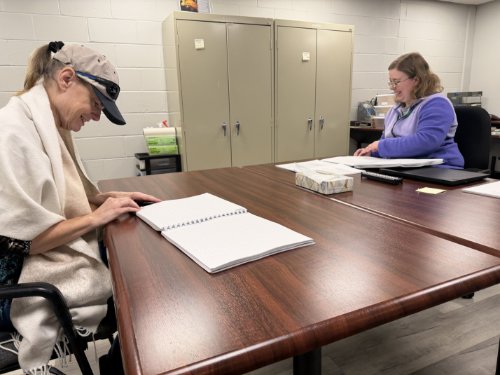
Amber Price, Instructor
Amber Price was born with cataracts in both eyes, and although they were successfully removed, she suffered vision issues and a decline throughout her childhood.She attended the Indiana School for the Blind, where she was introduced to Bosma and enrolled in their youth Student Training and Employment Program (STEP). After graduating high school, Amber went to Purdue University and received her bachelor's degree in Human Development.
“I had pushed away everything that had to do with being blind. I just wanted to be 'normal,' and then in 2023, I experienced a retinal detachment and was totally blind for three months. After surgery, I gained back most of my vision in my right eye, but was blind in my left," she said.
Her vision improved slowly but those three months of total blindness were a cautionary tale for Amber. In 2024, she entered Bosma Center for Visionary Solutions rehabilition training program and challenged herself not to let anything be "too hard."
Impressed with her attitude and determination during the rehab program, Matt Edwards, Employment Services Specialist, encouraged Amber to continue her progression in Bosma's workplace learning program (internship), which eventually led to full-time employment as a Braille Instructor at Bosma.
Amber has been fascinated with Braille since the third grade, and the opportunity to teach it to others and utilize her degree was exciting.
"Learning a skill like Braille can give a client the opportunity to become independent, confident, and, many times, more employable. It provides the opportunity to step into yourself and be more independent. It makes you more rounded and flexible in adapting to workplace situations.
"A lot of people think technology will eventually replace Braille, but I don't agree. Braille allows you to play cards and board games with your family, label medications, and quickly identify items in your home and workplace. I know it's not for everyone and that's okay. But for me? I love it!" Amber said.
Becky Gorball, Client
Becky lost her vision almost overnight. It happened in the fall of 2024 during an unrelated illness, and doctors are still unsure of its cause. Her diagnosis, after extensive testing, was neuroretinitis.The following spring, Becky's husband passed away.
When others might have folded their tents, Becky picked herself up and began putting the pieces in place to become independent and self-supporting.
"A long-time friend of mine, Angel, has low vision, as do her children, so I've been around people who are visually disabled, and I know they can be okay. They can have a good and happy life. It's all about attitude," Becky said.
Becky graduated from college with a bachelor's degree in Spanish and Vocal Performance and hopes to someday return to school to study speech-language pathology. She loves language, and her life experience would make her a natural to work in schools, hospitals, or rehab centers.
It's that love of language that brought Becky to Braille. While waiting for her Bosma training to begin, she contacted Hadley Institute for the Visually Impaired and began taking Braille classes remotely. Like Amber, Becky developed a love of Braille and has become a fast learner in Bosma's program.
This customized training is designed to help Hoosiers like Becky reach their individual goals and build the skills needed for independence. After graduating from her rehabilitation training, Becky plans to catch her breath and take what she calls "discovery" time to find out who she is, set her goals, and pull her plan together.
"I want to find a way to thrive, not just survive. I know it will be hard. I know I will not be as great at some things as I used to be." Becky said.
"But I'm going to learn how to live well without vision."
INDIANA DISABILITY AWARENESS MONTH PANEL DISCUSSION
March is Indiana Disability Awareness Month. On March 13, Bosma Center for Visionary Solutions hosted a panel discussion titled "Bridging the Gap — From Awareness to Actionable Inclusion." Click here to watch as we discuss the lived experiences of people with disabilities and strengthen the understanding of barriers that impact workplace inclusion.